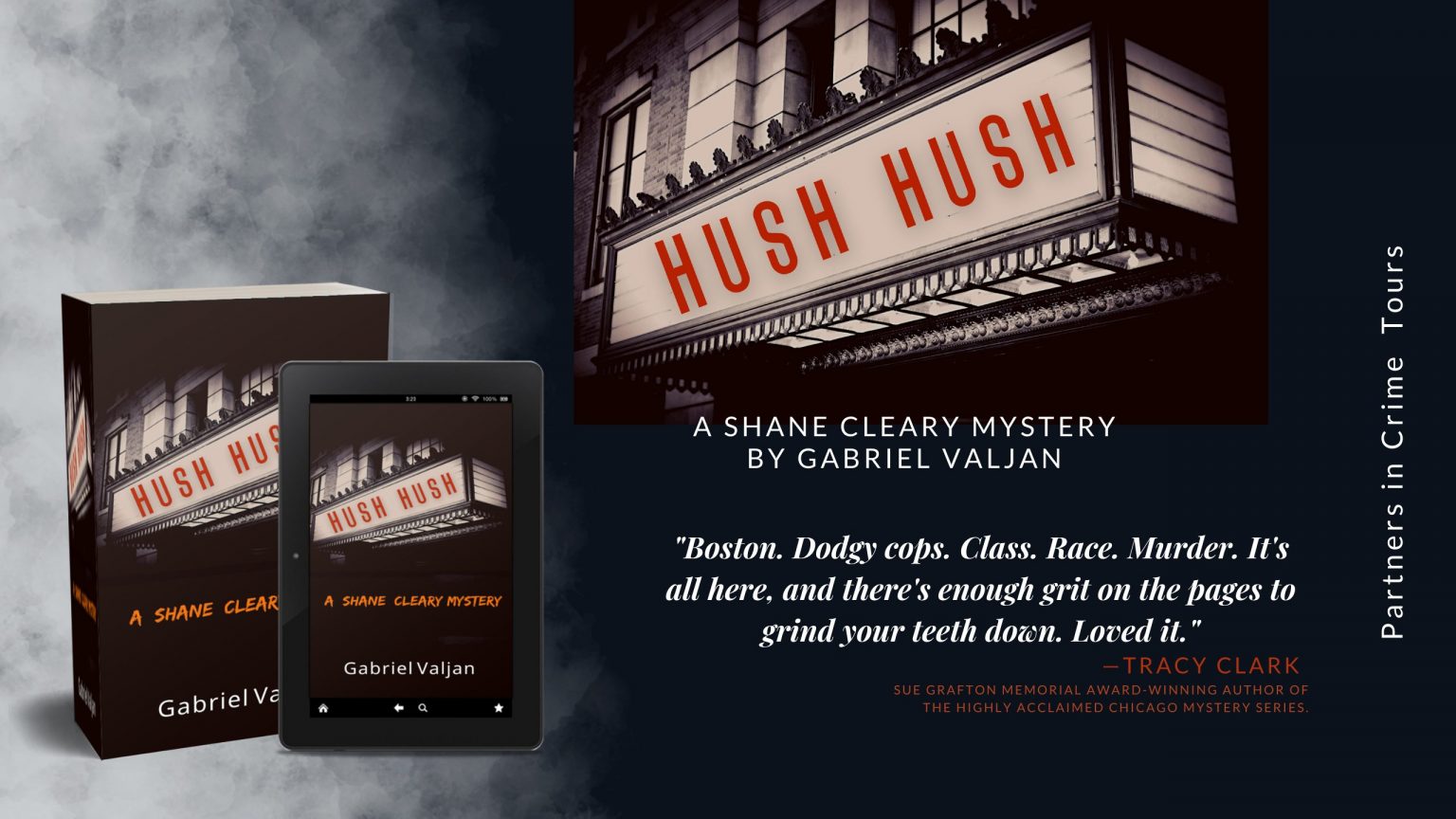
In association with Partners In Crime Virtual Book Tours, Jersey Girl Book Reviews is pleased to host the virtual book tour event for
Dirty Old Town by author
Gabriel Valjan!
Book Review
Dirty Old Town by Gabriel Valjan
Book 1: A Shane Cleary Mystery Series
Publisher: Level Best Books
Publication Date: January 14, 2020
Format: Paperback - 172 pages
Kindle - 1962 KB / 172 pages
Nook - 2 MB
ISBN: 978-1947915442
ASIN: B082XGX5NK
BNID: 978-1087857329
Genre: Mystery / Crime Fiction / Historical Fiction / Procedural
Buy The Book:
Disclaimer: I received a copy of the book via the author / publisher in exchange for my honest review and participation in a virtual book tour event hosted by Partners In Crime Virtual Book Tours.
Book Description:
“Robert B. Parker would stand and cheer, and George V. Higgins would join the ovation. This is a terrific book–tough, smart, spare, and authentic. Gabriel Valjan is a true talent–impressive and skilled–providing knock-out prose, a fine-tuned sense of place and sleekly wry style.”– Hank Phillippi Ryan, nationally bestselling author of The Murder List
Shane Cleary, a PI in a city where the cops want him dead, is tough, honest and broke. When he’s asked to look into a case of blackmail, the money is too good for him to refuse, even though the client is a snake and his wife is the woman who stomped on Shane’s heart years before. When a fellow vet and Boston cop with a secret asks Shane to find a missing person, the paying gig and the favor for a friend lead Shane to an arsonist, mobsters, a shady sports agent, and Boston’s deadliest hitman, the Barbarian. With both criminals and cops out to get him, the pressure is on for Shane to put all the pieces together before time runs out.
Book Excerpt:
The phone rang. Not that I heard it at first, but Delilah, who was lying next to me, kicked me in the ribs. Good thing she did because a call, no matter what the hour, meant business, and my cat had a better sense of finances than I did. Rent was overdue on the apartment, and we were living out of my office in downtown Boston to avoid my landlord in the South End. The phone trilled.
Again, and again, it rang.
I staggered through the darkness to the desk and picked up the receiver. Out of spite I didn’t say a word. I’d let the caller who’d ruined my sleep start the conversation.
“Mr. Shane Cleary?” a gruff voice asked.
“Maybe.”
The obnoxious noise in my ear indicated the phone had been handed to someone else. The crusty voice was playing operator for the real boss.
“Shane, old pal. It’s BB.”
Dread as ancient as the schoolyard blues spread through me. Those familiar initials also made me think of monogrammed towels and cufflinks. I checked the clock.
“Brayton Braddock. Remember me?”
“It’s two in the morning, Bray. What do you want?”
Calling him Bray was intended as a jab, to remind him his name was one syllable away from the sound of a jackass. BB was what he’d called himself when we were kids, because he thought it was cool. It wasn’t.
He thought it made him one of the guys. It didn’t, but that didn’t stop him. Money creates delusions. Old money guarantees them.
“I need your help.”
“At this hour?”
“Don’t be like that.”
“What’s this about, Bray?”
Delilah meowed at my feet and did figure eights around my legs. My gal was telling me I was dealing with a snake, and she preferred I didn’t take the assignment, no matter how much it paid us. But how could I not listen to Brayton Braddock III? I needed the money. Delilah and I were both on a first-name basis with Charlie the Tuna, given the number of cans of Starkist around the office. Anyone who told you poverty was noble is a damn fool.
“I’d rather talk about this in person, Shane.”
I fumbled for pen and paper.
“When and where?”
“Beacon Hill. My driver is on his way.”
“But—”
I heard the click. I could’ve walked from my office to the Hill. I turned on the desk light and answered the worried eyes and mew. “Looks like we both might have some high-end kibble in our future, Dee.”
She understood what I’d said. Her body bumped the side of my leg. She issued plaintive yelps of disapproval. The one opinion I wanted, from the female I trusted most, and she couldn’t speak human.
I scraped my face smooth with a tired razor and threw on a clean dress shirt, blue, and slacks, dark and pressed. I might be poor, but my mother and then the military had taught me dignity and decency at all times. I dressed conservatively, never hip or loud. Another thing the Army taught me was not to stand out. Be the gray man in any group. It wasn’t like Braddock and his milieu understood contemporary fashion, widespread collars, leisure suits, or platform shoes.
I choose not to wear a tie, just to offend his Brahmin sensibilities. Beacon Hill was where the Elites, the Movers and Shakers in Boston lived, as far back to the days of John Winthrop. At this hour, I expected Braddock in nothing less than bespoke Parisian couture. I gave thought as to whether I should carry or not. I had enemies, and a .38 snub-nose under my left armpit was both insurance and deodorant.
Not knowing how long I’d be gone, I fortified Delilah with the canned stuff. She kept time better than any of the Bruins referees and there was always a present outside the penalty box when I ran overtime with her meals. I meted out extra portions of tuna and the last of the dry food for her.
I checked the window. A sleek Continental slid into place across the street. I admired the chauffeur’s skill at mooring the leviathan. He flashed the headlights to announce his arrival. Impressed that he knew that I knew he was there, I said goodbye, locked and deadbolted the door for the walk down to Washington Street and the car.
Outside the air, severe and cold as the city’s forefathers, slapped my cheeks numb. Stupid me had forgotten gloves. My fingers were almost blue. Good thing the car was yards away, idling, the exhaust rising behind it. I cupped my hands and blew hot air into them and crossed the street. I wouldn’t dignify poor planning on my part with a sprint.
Minimal traffic. Not a word from him or me during the ride. Boston goes to sleep at 12:30 a.m. Public transit does its last call at that hour. Checkered hacks scavenge the streets for fares in the small hours before sunrise. The other side of the city comes alive then, before the rest of the town awakes, before whatever time Mr. Coffee hits the filter and grounds. While men and women who slept until an alarm clock sprung them forward into another day, another repeat of their daily routine, the sitcom of their lives, all for the hallelujah of a paycheck, another set of people moved, with their ties yanked down, shirts and skirts unbuttoned, and tails pulled up and out. The night life, the good life was on. The distinguished set in search of young flesh migrated to the Chess Room on the corner of Tremont and Boylston Streets, and a certain crowd shifted down to the Playland on Essex, where drag queens, truck drivers, and curious college boys mixed more than drinks.
The car was warmer than my office and the radio dialed to stultifying mood music. Light from one of the streetlamps revealed a business card on the seat next to me. I reviewed it: Braddock’s card, the usual details on the front, a phone number in ink. A man’s handwriting on the back when I turned it over. I pocketed it.
All I saw in front of me from my angle in the backseat was a five-cornered hat, not unlike a policeman’s cover, and a pair of black gloves on the wheel. On the occasion of a turn, I was given a profile. No matinee idol there and yet his face looked as familiar as the character actor whose name escapes you. I’d say he was mid-thirties, about my height, which is a liar’s hair under six-foot, and the spread of his shoulders hinted at a hundred-eighty pounds, which made me feel self-conscious and underfed because I’m a hundred-sixty in shoes.
He eased the car to a halt, pushed a button, and the bolt on my door shot upright. Job or no job, I never believed any man was another man’s servant. I thanked him and I watched the head nod.
Outside on the pavement, the cold air knifed my lungs. A light turned on. The glow invited me to consider the flight of stairs with no railing. Even in their architecture, Boston’s aristocracy reminded everyone that any form of ascent needed assistance.
A woman took my winter coat, and a butler said hello. I recognized his voice from the phone. He led and I followed. Wide shoulders and height were apparently in vogue because Braddock had chosen the best from the catalog for driver and butler. I knew the etiquette that came with class distinction. I would not be announced, but merely allowed to slip in.
Logs in the fireplace crackled. Orange and red hues flickered against all the walls. Cozy and intimate for him, a room in hell for me. Braddock waited there, in his armchair, Hefner smoking jacket on. I hadn’t seen the man in almost ten years, but I’ll give credit where it’s due. His parents had done their bit after my mother’s death before foster care swallowed me up. Not so much as a birthday or Christmas card from them or their son since then, and now their prince was calling on me.
Not yet thirty, Braddock manifested a decadence that came with wealth. A pronounced belly, round as a teapot, and when he stood up, I confronted an anemic face, thin lips, and a receding hairline. Middle-age, around the corner for him, suggested a bad toupee and a nubile mistress, if he didn’t have one already.
He approached me and did a boxer’s bob and weave. I sparred when I was younger. The things people remembered about you always surprised me. Stuck in the past, and yet Braddock had enough presence of mind to know my occupation and drop the proverbial dime to call me.
“Still got that devastating left hook?” he asked.
“I might.”
“I appreciate your coming on short notice.” He indicated a chair, but I declined. “I have a situation,” he said. He pointed to a decanter of brandy. “Like some…Henri IV Heritage, aged in oak for a century.”
He headed for the small bar to pour me some of his precious Heritage. His drink sat on a small table next to his chair. The decanter waited for him on a liquor caddy with a glass counter and a rotary phone. I reacquainted myself with the room and décor.
I had forgotten how high the ceilings were in these brownstones. The only warm thing in the room was the fire. The heating bill here alone would’ve surpassed the mortgage payment my parents used to pay on our place. The marble, white as it was, was sepulchral. Two nude caryatids for the columns in the fireplace had their eyes closed. The Axminster carpet underfoot, likely an heirloom from one of Cromwell’s cohorts in the family tree, displayed a graphic hunting scene.
I took one look at the decanter, saw all the studded diamonds, and knew Elizabeth Taylor and Richard Burton would have done the set number of paces with a pair of hand-wrought dueling pistols to own it.
Bray handed me a snifter of brandy and resumed his place in his chair. I placed my drink on the mantel.
“Tell me more about this situation you have.”
“Quite simple, really. Someone in my company is blackmailing me.”
“And which company is that?”
“Immaterial at the moment. Please do take a seat.”
I declined his attempt at schmooze. This wasn’t social. This was business.
“If you know who it is,” I said, “and you want something done about it, I’d recommend the chauffeur without reservation, or is it that you’re not a hundred percent sure?”
I approached Bray and leaned down to talk right into his face. I did it out of spite. One of the lessons I’d learned is that the wealthy are an eccentric and paranoid crowd. Intimacy and germs rank high on their list of phobias.
“I’m confident I’ve got the right man.” Brayton swallowed some of his expensive liquor.
“Then go to the police and set up a sting.”
“I’d like to have you handle the matter for me.”
“I’m not muscle, Brayton. Let’s be clear about that. You mean to say a man of your position doesn’t have any friends on the force to do your dirty work?”
“Like you have any friends there?”
I threw a hand onto each of the armrests and stared into his eyes. Any talk about the case that bounced me off the police force and into the poorhouse soured my disposition. I wanted the worm to squirm.
“Watch it, Bray. Old bones ought to stay buried. I can walk right out that door.”
“That was uncalled for, and I’m sorry,” he said. “This is a clean job.”
Unexpected. The man apologized for the foul. I had thought the word “apology” had been crossed out in his family dictionary. I backed off and let him breathe and savor his brandy.
I needed the job. The money. I didn’t trust Bray as a kid, nor the man the society pages said saved New England with his business deals and largesse.
“Let’s talk about this blackmail then,” I said. “Think one of your employees isn’t happy with their Christmas bonus?”
He bolted upright from his armchair. “I treat my people well.”
Sensitive, I thought and went to say something else, when I heard a sound behind me, and then I smelled her perfume. Jasmine, chased with the sweet burn of bourbon. I closed my eyes, and when I opened them I saw his smug face.
“You remember Cat, don’t you?”
“How could I not?” I said and kissed the back of the hand offered to me. Cat always took matters one step forward. She kissed me on the cheek, close enough that I could feel her against me. She withdrew and her scent stuck to me. Cat was the kind of woman who did all the teaching and you were grateful for the lessons. Here we were, all these years later, the three of us in one room, in the middle of the night.
“Still enjoy those film noir movies?” she asked.
“Every chance I get.”
“I’m glad you came at my husband’s request.”
The word husband hurt. I had read about their marriage in the paper.
“I think you should leave, dear, and let the men talk,” her beloved said.
His choice of words amused me as much as it did her, from the look she gave me. I never would have called her “dear” in public or close quarters. You don’t dismiss her, either.
“Oh please,” she told her husband. “My sensibility isn’t that delicate and it’s not like I haven’t heard business discussed. Shane understands confidentiality and discretion. You also forget a wife can’t be forced to testify against her husband. Is this yours, Shane?” she asked about the snifter on the brandy on the mantel. I nodded. “I’ll keep it warm for you.”
She leaned against the mantel for warmth. She nosed the brandy and closed her eyes. When they opened, her lips parted in a sly smile, knowing her power. Firelight illuminated the length of her legs and my eyes traveled. Braddock noticed and he screwed himself into his chair and gave her a venomous look.
“Why the look, darling?” she said. “You know Shane and I have history.”
Understatement. She raised the glass. Her lips touched the rim and she took the slightest sip. Our eyes met again and I wanted a cigarette, but I’d quit the habit. I relished the sight until Braddock broke the spell. He said, “I’m being blackmailed over a pending business deal.”
“Blackmail implies dirty laundry you don’t want aired,” I said. “What kind of deal?”
“Nothing I thought was that important,” he said.
“Somebody thinks otherwise.”
“This acquisition does have certain aspects that, if exposed, would shift public opinion, even though it’s completely aboveboard.” Braddock sipped and stared at me while that expensive juice went down his throat.
“All legit, huh,” I said. “Again, what kind of acquisition?”
“Real estate.”
“The kind of deal where folks in this town receive an eviction notice?”
He didn’t answer that. As a kid, I’d heard how folks in the West End were tossed out and the Bullfinch Triangle was razed to create Government Center, a modern and brutal Stonehenge, complete with tiered slabs of concrete and glass. Scollay Square disappeared overnight. Gone were the restaurants and the watering holes, the theaters where the Booth brothers performed, and burlesque and vaudeville coexisted. Given short notice, a nominal sum that was more symbolic than anything else, thousands of working-class families had to move or face the police who were as pleasant and diplomatic as the cops at the Chicago Democratic National Convention.
I didn’t say I’d accept the job. I wanted Braddock to simmer and knew how to spike his temperature. I reclaimed my glass from Cat. She enjoyed that. “Pardon me,” I said to her. “Not shy about sharing a glass, I hope.”
“Not at all.”
I let Bray Braddock cook. If he could afford to drink centennial grape juice then he could sustain my contempt. I gulped his cognac to show what a plebe I was, and handed the glass back to Cat with a wink. She walked to the bar and poured herself another splash, while I questioned my future employer. “Has this blackmailer made any demands? Asked for a sum?”
“None,” Braddock answered.
“But he knows details about your acquisition?” I asked.
“He relayed a communication.”
Braddock yelled out to his butler, who appeared faster than recruits I’d known in Basic Training. The man streamed into the room, gave Braddock two envelopes, and exited with an impressive gait. Braddock handed me one of the envelopes.
I opened it. I fished out a thick wad of paperwork. Photostats. Looking them over, I saw names and figures and dates. Accounting.
“Xeroxes,” Braddock said. “They arrived in the mail.”
“Copies? What, carbon copies aren’t good enough for you?”
“We’re beyond the days of the hand-cranked mimeograph machine, Shane. My partners and I have spared no expense to implement the latest technology in our offices.”
I examined pages. “Explain to me in layman’s terms what I’m looking at, the abridged version, or I’ll be drinking more of your brandy.”
The magisterial hand pointed to the decanter. “Help yourself.”
“No thanks.”
“Those copies are from a ledger for the proposed deal. Keep them. Knowledgeable eyes can connect names there to certain companies, to certain men, which in turn lead to friends in high places, and I think you can infer the rest. Nothing illegal, mind you, but you know how things get, if they find their way into the papers. Yellow journalism has never died out.”
I pocketed the copies. “It didn’t die out, on account of your people using it to underwrite the Spanish-American War. If what you have here is fair-and-square business, then your problem is public relations—a black eye the barbershops on Madison Ave can pretty up in the morning. I don’t do PR, Mr. Braddock. What is it you think I can do for you?”
“Ascertain the identity of the blackmailer.”
“Then you aren’t certain of…never mind. And what do I do when I ascertain that identity?”
“Nothing. I’ll do the rest.”
“Coming from you, that worries me, seeing how your people have treated the peasants, historically speaking.”
Brayton didn’t say a word to that.
“And that other envelope in your lap?” I asked.
The balding halo on the top of his head revealed itself when he looked down at the envelope. Those sickly lips parted when he faced me. I knew I would hate the answer. Cat stood behind him. She glanced at me then at the figure of a dog chasing a rabbit on the carpet.
“Envelope contains the name of a lead, an address, and a generous advance. Cash.”
Brayton tossed it my way. The envelope, fat as a fish, hit me. I caught it.
My Book Review:
In
Dirty Old Town, book one in the
Shane Cleary Mystery Series, author Gabriel Valjan
takes the reader behind the scenes of a riveting crime fiction as down and out ex-Boston cop turned PI Shane Cleary navigates the slippery slope of investigating a blackmail case and a missing person case, while trying to stay below the radar of the Boston PD brethren that he had betrayed.
Dirty Old Town is a riveting crime story that easily draws the reader in from the start. The author provides the reader with a fascinating and richly detailed crime thriller set in 1970s Boston. Told in the first person narrative by Shane, this gritty story has enough drama, secrets, deception, tension, and surprising twists and turns that keeps the reader guessing if Shane will be able to solve both cases, while dealing with backstabbing old friends, mobsters, and a variety of criminal types that try to hinder his every move. I loved the throwback to the 1970s decade, and I really appreciated reading about Shane's past.
Dirty Old Town is a well-written, fast paced story that left me interested in finding out what Shane's next investigative adventure will be in the continuation of the series.
RATING: 4 STARS
About The Author
Gabriel Valjan is the author of two series,
Roma and
Company Files, with Winter Goose Publishing.
Dirty Old Town is the first in the
Shane Cleary series for Level Best Books. His short stories have appeared online, in journals, and in several anthologies. He has been a finalist for the Fish Prize, shortlisted for the Bridport Prize, and received an Honorable Mention for the Nero Wolfe Black Orchid Novella Contest in 2018. You can find him on Twitter (@GValjan) and Instagram (gabrielvaljan). He lurks the hallways at crime fiction conferences, such as Bouchercon, Malice Domestic, and New England Crime Bake. Gabriel is a lifetime member of Sisters in Crime.
Author Website
Amazon Author Page
Facebook
Twitter
BookBub
Instagram
Goodreads
Contest Giveaway
Win A $20 Amazon Gift Card
This is a rafflecopter giveaway hosted by Partners in Crime Virtual Book Tours for Gabriel Valjan. There will be one (1) winner. The winner will receive an Amazon.com Gift Card. The giveaway begins on March 1, 2020 and runs through May 2, 2020. Void where prohibited.
a Rafflecopter giveaway
Virtual Book Tour Event
Tour Participants:
03/01 Showcase @ Lisa-Queen of Random
03/02 Showcase @ BooksChatter
03/03 Review @ Book Reviews From an Avid Reader
03/04 Showcase @ Eclectic Moods
03/05 Interview @ Mythical Books
03/07 Interview @ A Blue Million Books
03/08 Showcase @ Just 4 My Books
03/12 Showcase @ The Pulp and Mystery Shelf
03/20 Review/showcase @ Our Town Book Reviews
03/21 Review @ michellemengsbookblog
03/23 Guest post @ Nesies Place
03/25 Interview @ Quiet Fury Books
03/26 Interview @ Just Books
04/02 Showcase @ Archaeolibrarian - I Dig Good Books!
04/03 Showcase @ Lauras Interests
04/05 Showcase @ EienCafe
04/09 Review/showcase @ CMash Reads
04/15 Review @ Bound 4 Escape
04/18 Review @ Diane Reviews Books
04/20 Guest post @ The Book Divas Reads
04/20 Showcase @ Im Into Books
04/24 Interview @ Jersey Girl Book Reviews
04/28 Interview @ Blog Talk Radio
04/28 Review @ Just Reviews
04/30 Showcase @ Teatime and Books